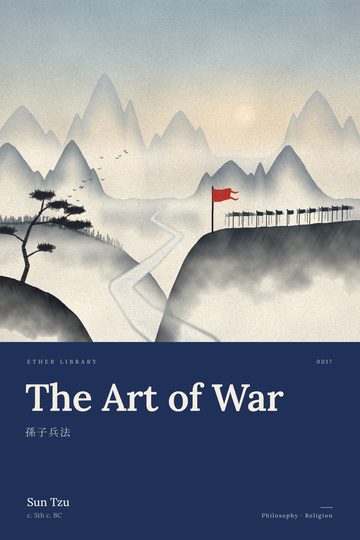
The Art of War
孫子兵法
EditionTranslated from the original Classical Chinese
Thirteen short chapters on when to fight, how to win, and why the best victory is the one that needs no battle.
Audiobook
I. Initial Calculations
Start from the beginning · 3:08
Chapters 13
Anyone can listen to the first chapter. Sign up free to hear the rest and keep your place on your account.
Also in the library: the complete Korean translation.
Anyone can read the first chapter. Join free to read to the end and download EPUB and PDF.
DRM-free files. Translation CC BY-NC 4.0; the original work is in the public domain.
About the book
Sun Wu, known as Master Sun, is said to have served as a general under the king of Wu at the end of the sixth century BC. The thirteen chapters handed down under his name cover the whole of war: the calculations made before it begins, its cost to the state, form and momentum, the empty and the full, the ground an army moves over, attack by fire, and the use of spies. They state principles and give commands, and they rarely stop to argue.
This complete English translation is made directly from the Classical Chinese of the received thirteen-chapter text, with each of its eighty-eight paragraphs kept as one. Sun Tzu’s key terms are rendered by one English word each throughout, and nothing from the later commentators has been folded into the text. Twenty-two short notes identify persons, states, and measures.
Highlights
- War is the way of deception.
- To subdue the enemy’s army without fighting is the height of skill.
- One who knows himself and knows the enemy will not be in danger in a hundred battles.
Contents
Anyone can read up to the first chapter. Chapters with a lock are open to free members.
Colophon
Translated from the original Classical Chinese. Licensed CC BY-NC 4.0.Full colophon
The Art of War
Original title · 孫子兵法 (Sunzi bingfa)
Author · Sun Tzu (Sun Wu, fl. late sixth century BC)
Translator · Ether Library
Composition · Fifth century BC or somewhat later, in the state of Wu; the thirteen-chapter text has been standard since the commentary of Cao Cao (early third century AD).
Source text · A public-domain digital transcription of the received thirteen-chapter text. Misprints corrected by the received text. Translated directly from the Classical Chinese.
Extent · Complete and unabridged · thirteen chapters · 88 paragraphs · 22 short translator’s notes
Copyright · An ancient work; the original is in the public domain throughout the world.
This translation · Translated from the Classical Chinese by Ether Library. The English text is © Ether Library and is licensed under Creative Commons Attribution-NonCommercial 4.0 International (CC BY-NC 4.0): you may copy and share it for noncommercial purposes, with attribution.
Edition · English edition 1.0 · October 2026
Typography · Set in Lora (SIL Open Font License 1.1). Cover painting and design by Ether Library.
Original in the public domain · English translation CC BY-NC 4.0
Ether Library · No. 0017