Be the CEO of You, Inc.: Owning Your Decisions When AI Does the Work
How to be the CEO of your own life when AI drafts, researches, and recommends: what a fake-case lawsuit and Machiavelli teach about owning the final call.
Contents

In 2023, two New York lawyers working on a personal-injury case against the airline Avianca filed papers citing court decisions that supported their client. There was one problem: several of those decisions didn't exist. ChatGPT had been used for the legal research, and it had produced convincing-looking cases out of thin air. Even after the court questioned whether the cases existed, the lawyers kept standing by them for a while.
The judge, P. Kevin Castel of the Southern District of New York, was not interested in blaming the software. In his June 2023 sanctions order, he wrote that "existing rules impose a gatekeeping role on attorneys to ensure the accuracy of their filings," and that the lawyers had "abandoned their responsibilities." They and their firm were fined $5,000.
In early 2024, a Canadian tribunal heard a smaller case with the same shape. Air Canada's website chatbot had told a grieving customer, Jake Moffatt, that he could apply for a bereavement discount after he flew. That was wrong. When Moffatt asked for his money, Air Canada argued, among other things, that the chatbot was effectively a separate entity responsible for its own actions. The tribunal rejected that, saying the airline was responsible for all the information on its website, chatbot included, and ordered it to pay about C$650 plus interest and fees.
Two cases, one lesson, and it applies far beyond courtrooms: the tool can do the work, but it can't take the blame. Somebody always owns the decision. In your life, that somebody is you.
Everyone's a manager now
The business world has noticed. In its 2025 Work Trend Index, Microsoft predicted the rise of what it called the "agent boss," someone who "builds, delegates to and manages agents," and said that "every worker will need to think like the CEO of an agent-powered startup." Take that with the grain of salt you'd apply to any forecast from a company that sells AI agents. But the basic observation is hard to argue with. More and more of us now hand off research, drafts, summaries, and recommendations to software, and then decide what to do with what comes back.
The CEO metaphor isn't new, either. In a 1997 Fast Company cover story, the management writer Tom Peters told readers: "We are CEOs of our own companies: Me Inc." His point was about careers and personal branding in an economy where loyalty to one employer was fading.
The AI version adds a twist Peters couldn't have predicted. Being the CEO of You, Inc. now means having a staff for the first time. A tireless, fast, cheerful staff that never says "I'm not sure." And the hardest part of having a staff, as every new manager discovers, is not getting work out of people. It's remembering that you're still the one accountable for it.
Delegation is not abdication
Real CEOs delegate almost everything. They don't write the code, build the product, or answer the phones. What they keep is a small set of jobs nobody else can do for them: setting direction, choosing between options, and taking responsibility for the outcome.
There's a phrase for what happens when that last job gets handed off too. Delegation becomes abdication. The Avianca lawyers delegated the research, which was reasonable, and then abdicated the judgment, which wasn't. Air Canada delegated customer service to a bot, then tried to abdicate the consequences.
You can see the same slide in everyday life, just with lower stakes:
- You ask AI which of two job offers looks better, and take the answer without asking what it can't know about you.
- You let a budgeting app's "recommended" plan run for a year without ever looking at whether it fits your actual goals.
- You let an AI-written message go to your sister about a family conflict because it sounded calm and reasonable, and it wasn't really what you meant.
None of these are disasters. That's what makes them easy. Each one is a small moment where a decision got made and nobody quite made it.
What makes it worse is a quiet psychological fact. As we wrote yesterday in why reading and writing still matter in the age of AI, a 2025 Microsoft and Carnegie Mellon survey of knowledge workers found that the more people trusted the AI, the less critical thinking they reported doing. Confidence in the tool tends to crowd out the checking. A good CEO knows this about their staff. The most persuasive report is the one you're least likely to question.
Machiavelli's river
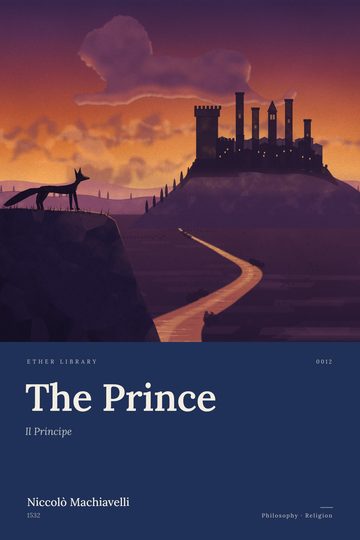
Niccolò Machiavelli has a reputation as the patron saint of ruthlessness, but the chapter of The Prince that might matter most today is about something else entirely: how much of life we actually control. In Chapter XXV, he takes on people who believe everything is ruled by luck, so there's no point trying. His answer:
Nevertheless, so that our free will may not be extinguished, I judge that it may be true that fortune is the arbiter of half our actions, but that she still leaves the other half, or close to it, for us to govern.
Then he compares fortune to a river in flood that tears down trees and buildings. Nobody can stop it once it's raging. "And although they are like this," he writes, "it does not follow that men, when the weather is quiet, cannot make provision against them with dikes and embankments."
That's the CEO job, described five hundred years early. You don't control the flood. You do control what you build when the weather is quiet.
For the AI age, the dikes are decisions you make before the moment of pressure. What will I always check? What will I never hand off? What do I actually want, so I can tell when a recommendation is pulling me somewhere else? People who've thought those questions through in advance aren't at the mercy of whatever the tool says in the moment. People who haven't are, and it's usually not because they're lazy. It's because the flood arrives on a busy Tuesday, when the easiest thing is to accept the answer and move on.
Running You, Inc.
If you want to treat your life a little more like a company you're responsible for, here are a few practices that don't require an MBA.
Write a short "what's mine" list. Three to five decisions you'll always make yourself, whatever tools you use. Where your money goes. What you say to people you love. What you sign your name to. Anything you'll have to defend later. AI can help you think about these. It doesn't get the final vote.
Ask for options, not answers. "What should I do?" invites the tool to decide. "Give me three options, with what each one costs and risks" keeps you in the CEO chair. Then add a fourth option the AI didn't list. There almost always is one.
Check in proportion to the stakes. You don't need to fact-check a dinner recipe. You do need to check anything that affects your health, your money, your job, or another person. The Avianca lawyers would have saved themselves a lot of grief by looking up a single case.
Keep a one-line decision log. When you make a real decision, write the date, what you chose, and why. It takes a minute. A few months later, it lets you see your own judgment working, and spot when you stopped using it. It also makes the next decision easier, because you can see what you actually value instead of what you meant to value.
Own the result out loud. When something you decided goes wrong, say "I decided that" instead of "the app said." It feels worse for about ten seconds. Then it feels like being in charge of your own life, which is the whole point.
One thought to take with you
The question in the AI age isn't whether you'll use these tools. You will, and you should. The question is whether, five years from now, the shape of your life will be something you chose or something that accumulated from a thousand accepted suggestions.
Machiavelli thought we govern about half of what happens to us. That half is still yours. You can delegate the drafting, the research, even the first opinion. The decision, and the life it adds up to, doesn't transfer.
If you want to see where the river comparison comes from, you can read The Prince free in the Ether Library. Chapter XXV is only a few pages long, and it's a good one to read in quiet weather.
Sources
- Bob Ambrogi, "Court Imposes Sanctions on Lawyers Who Filed Bogus Cases After Relying on ChatGPT for Legal Research," LawSites, June 22, 2023 (on Mata v. Avianca, Inc., S.D.N.Y. No. 22-cv-1461): https://www.lawnext.com/2023/06/court-imposes-sanctions-on-lawyers-who-filed-bogus-cases-after-relying-on-chatgpt-for-legal-research.html
- American Bar Association, Business Law Today, "BC Tribunal Confirms Companies Remain Liable for Information Provided by AI Chatbot," February 2024 (on Moffatt v. Air Canada, 2024 BCCRT 149): https://www.americanbar.org/groups/business_law/resources/business-law-today/2024-february/bc-tribunal-confirms-companies-remain-liable-information-provided-ai-chatbot/
- Microsoft, "The 2025 Annual Work Trend Index: The Frontier Firm is born," April 23, 2025: https://blogs.microsoft.com/blog/2025/04/23/the-2025-annual-work-trend-index-the-frontier-firm-is-born/
- Tom Peters, "The Brand Called You," Fast Company, 1997, as excerpted by Ed Batista, "Brand You in the 21st Century," 2009: https://edbatista.com/2009/07/brand-you.html
- Hao-Ping (Hank) Lee et al., "The Impact of Generative AI on Critical Thinking," CHI 2025: https://advait.org/files/lee_2025_ai_critical_thinking_survey.pdf
- Niccolò Machiavelli, The Prince (1532), Chapter XXV, quoted from the Ether Library English translation.
Made by people and AI together. The EtherXync team sets the topic and direction; research and drafting are done with an AI (Claude). Quotes and numbers are checked and sourced. How we make it