Is It OK to Not Finish a Book? Why One Sentence Can Be the Whole Win
Is it OK to not finish a book? What Kindle highlights, Pew surveys, and Thoreau suggest about reading wins that never show up on a finished-books list.
Contents

In the summer of 2014, the mathematician Jordan Ellenberg ran a cheeky little experiment for The Wall Street Journal. Kindle used to show everyone the passages readers highlighted most. Ellenberg reasoned that if those popular highlights were all bunched up in the first few chapters, most people had probably stopped reading there. He turned that into a score and named it the Hawking Index, after A Brief History of Time, the famous bestseller that nobody seemed to get through.
The numbers were funny and a little brutal. The Goldfinch scored 98.5%, so people really did finish it. A Brief History of Time came in at 6.6%. Thinking, Fast and Slow was 6.8%. And Thomas Piketty's Capital in the Twenty-First Century, the most talked-about book of that year, scored 2.4%. By that rough measure, the typical buyer of a doorstop about inequality stopped somewhere in the opening chapters.
It's an informal measure, and Ellenberg never claimed otherwise. Highlights aren't a perfect stand-in for reading. But the joke landed because it was true for nearly all of us. We have shelves full of books we started with real hope. And somewhere along the way many of us decided those books don't count.
So is it OK to not finish a book? Yes. But the more useful question is what a "win" in reading actually looks like, because the answer is bigger than a finished-books list.
The finished-books scoreboard
Look at how reading gets counted in American life. Goodreads gives you a yearly challenge with a progress bar. Book clubs meet when everybody's "done." School taught most of us that a book is a unit of work you either completed or didn't, and the test was there to check.
Then there's the bigger picture, which isn't great. In August 2025, researchers from University College London and the University of Florida published a study in iScience using the American Time Use Survey, which tracked more than 236,000 Americans from 2003 to 2023. On an average day in 2004, about 28% of Americans read for pleasure. By 2023, it was 16%.
When reading is shrinking like that, it's tempting to double down on the scoreboard: more books, more pages, finish what you start. But a scoreboard that only counts completions has a side effect. It makes every unfinished book feel like a small failure. And a pile of small failures is one of the most reliable ways to make a person stop picking up books at all.
Interestingly, the people who study reading for a living don't count it that strictly. When the Pew Research Center asks Americans about reading, it asks whether they've read a book "in whole or in part" in the past twelve months. In its 2021 survey, about 23% of U.S. adults said they hadn't read any book even partly. The researchers count the partial readers as readers. That's a quiet, sensible choice. It admits what we all know: a lot of real reading happens inside books we never close at the last page.
What actually changes a mind
Think about a book that genuinely changed how you see something. Now try to remember what changed it.
For most people, it isn't the whole book. It's a scene, a paragraph, sometimes a single sentence. A line about grief that finally put words to something you'd been carrying for two years. A sentence in a business book that made you rethink how you run Monday meetings. A passage in an old novel that made you call your mother.
Those moments rarely come on schedule. You can't plan to meet them on page 112. Often the sentence that matters is sitting in a chapter you almost skipped, in a book you almost put down. And here's the odd part: it often doesn't land the first time. You read it, it slides past, and three weeks later, in the shower or stuck in traffic on I-95, it comes back and rearranges something.
That's why "did you finish it?" is a strange question to ask about a book. A better one is "did anything in it stay with you?" If the answer is yes, the book did its job, even if you only got a third of the way in.
The French novelist Daniel Pennac made this case years ago in his 1992 book Comme un roman, published in English as The Rights of the Reader. His list of ten "inalienable" rights includes "the right to skip," "the right not to finish a book," and "the right to dip in." The librarian Nancy Pearl, who's practically a national treasure among American readers, offers a practical version she calls the Rule of 50: give a book 50 pages, then ask yourself whether you're really liking it. If you're over 50, subtract your age from 100 and read that many pages instead. Life is short, and it gets shorter, so the number shrinks as you age.
Thoreau's version: dating a new era from a book
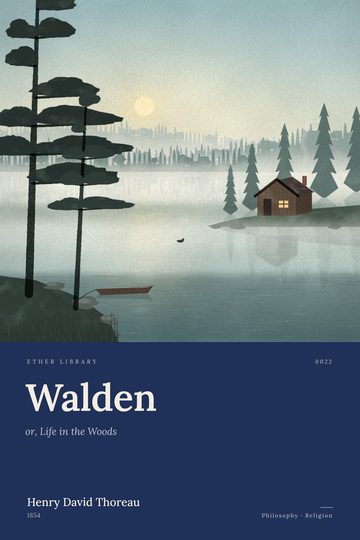
Henry David Thoreau would have understood all of this, though he'd have put it more grandly. In the chapter of Walden called "Reading," he argues that most of us read too lightly and settle for "easy reading," and then, in the middle of that scolding, he says something generous:
How many a man has dated a new era in his life from the reading of a book! The book exists for us, perchance, which will explain our miracles and reveal new ones.
Notice what he's counting. Not books finished per year. He's counting turning points: the day a book changed the direction of a life. That's a very different scoreboard. One sentence can put a new era on your calendar. A hundred finished books that changed nothing don't.
But notice the other half too, because Thoreau isn't letting anyone off easy. In the same chapter, he insists that "books must be read as deliberately and reservedly as they were written." He wants us to work. He isn't telling us to skim for quotable lines and bail.
And that's the tension worth sitting with.
Finishing and the one sentence aren't rivals
It would be easy to turn this into a slogan: forget finishing, just hunt for great lines. That would be a mistake, and it would actually make you less likely to find them.
The sentences that change us almost never work alone. They hit hard because of everything that came before them. A line in the last chapter of a novel lands because you spent 300 pages with the character who says it. A sentence in an old essay knocks you over because the author spent ten pages building the problem it solves. Pull that sentence out and post it on Instagram, and it's a nice quote. Meet it at the end of the road, and it can change your mind.
So the two ideas help each other:
Finishing builds the context that lets a sentence hit. Sometimes the sentence you need is on page 280. If you'd quit at 50, you'd never meet it. Some books, especially classics, ask you to wade through slow opening chapters before they start paying out. Thoreau's Walden itself opens with a long, prickly chapter about economy that loses a lot of first-time readers. The famous passages come later.
The one sentence is what keeps you finishing. Nobody reads a hard book to the end on willpower alone. You keep going because something earlier caught you. One good line gives you a reason to see where the author is headed.
Quitting is fine when nothing is catching. If you've given a book a fair chance, Pearl's 50 pages or your own version, and nothing has caught, put it down without guilt. You're not giving up on reading. You're making room for the book that has your sentence in it.
How to count the wins that don't show up on a list
If you want to keep a scoreboard, keep a better one. A few small habits help:
Keep a "sentences" page. In the back of a notebook, or a note on your phone, write down any sentence that stops you. Add the book and the date. Over a year this becomes a strangely personal document, a map of what you were working through at the time. Many readers find it more satisfying than a list of titles.
Mark the moment, not just the line. Next to the sentence, write one line about why it hit you today. "Thinking about Dad's retirement." "This is exactly the fight with my manager." That note is the real win. It's the proof that reading did something.
Reread before you quit. If you're about to put a book down, flip back to the last passage you marked. Sometimes that's enough to pull you back in. If it isn't, that's useful information too.
Give old books a second chance later. A book that bored you at 22 can wreck you at 40. The sentence didn't change. You did. Putting a book down "for now" is very different from rejecting it forever.
Count partial reads as reading. If Pew can, you can. A third of a great book still counts.
One thing to take with you
Here's the thought worth carrying out of this post. Maybe the goal of reading was never to finish books. Maybe it's to be changed by them, a little at a time, and finishing is just one of the ways that happens.
Some books you'll read to the last page because the ending is the point. Some you'll leave on page 60 and think about for years. Neither one is a failure. The question at the end of a reading year isn't how long the list is. It's whether there's a sentence you're still carrying around.
If you want to go looking for one, the "Reading" chapter of Walden is short and full of candidates. You can read Walden free in the Ether Library, and if you're curious where else to find classics legally and for nothing, we put together a guide to free classic books online.
Sources
- Jordan Ellenberg, "The Summer's Most Unread Book Is...," The Wall Street Journal, July 2014. Summary of the Hawking Index figures: https://en.wikipedia.org/wiki/Hawking_Index
- University College London, "Proportion of Americans reading for pleasure fell by 40% over 20 years," August 20, 2025 (on Jessica Bone et al., iScience, using the American Time Use Survey 2003–2023): https://www.ucl.ac.uk/news/2025/aug/proportion-americans-reading-pleasure-fell-40-over-20-years
- Pew Research Center, "Who doesn't read books in America?," September 21, 2021: https://www.pewresearch.org/short-reads/2021/09/21/who-doesnt-read-books-in-america/
- Daniel Pennac, The Rights of the Reader (originally Comme un roman, 1992), list as reproduced by Gretchen Rubin: https://gretchenrubin.com/articles/the-10-inalienable-rights-of-the-reader/
- "Nancy Pearl's Revised 'Rule of 50'," Shelf Awareness, February 10, 2011: https://www.shelf-awareness.com/theshelf/2011-02-10/nancy_pearls_revised_rule_of_50.html
- Henry David Thoreau, Walden (1854), chapter "Reading," quoted from the Ether Library English edition.
Made by people and AI together. The EtherXync team sets the topic and direction; research and drafting are done with an AI (Claude). Quotes and numbers are checked and sourced. How we make it