How to Spot the Next Big Thing, According to a Korean Doctor Who Missed the First One
How do you spot the next big thing before everyone else? A famous 2008 lecture by Korean surgeon Park Kyung-chul, plus Thoreau and AI, on noticing change early.
Contents

This post is built on a lecture most Americans have never heard of. In 2008, Park Kyung-chul, a Korean surgeon who writes under the nickname "Country Doctor" and became unusually well known for his investing, gave a special lecture at Ajou University in South Korea. Its title translates roughly as "In Search of W." We worked from a 2022 re-upload on a Korean YouTube channel called 부자일기 ("Rich Diary"), whose description identifies it as the 2008 Ajou lecture (watch it here, in Korean). We couldn't locate the original upload. Part one below is checked against that video's transcript; part two comes from several independent Korean write-ups, and we kept only what they agree on. When we say "the lecture says," that's Park. When we say "here's our take," that's us.
The lecture: two people, one talk, two futures
It's 1993. Park has just qualified as a surgeon and taken a job at a brand-new hospital in Daejeon, lured by triple the usual salary. The catch: he is the only surgeon, covering the clinic, the operating room, and the night emergencies alone. Three weeks in, barely sleeping, he gets a call from a friend at an economics think tank in Seoul. A brilliant guy is giving a talk about where society is headed, the friend says. Skip it and you'll regret it for the rest of your life.
Park hangs up. But "the rest of your life" keeps ringing in his ears, even mid-surgery. So he tells his hospital director there's a colon-cancer seminar in Seoul and heads up, dragging along the one friend free on a weekday afternoon: a guy fresh back from an MBA in Texas who hadn't found a job.
The auditorium is packed with PhD researchers. The speaker walks out in ripped jeans and a baseball cap, writes a W on the board, and announces that a "WWW" world is coming, one that banks and brokerages will move into. Ten minutes in, people start leaving from the back. Thirty minutes in, only the front rows remain. Park files it under "game developer with delusions of grandeur." In the lecture, he simply calls this speaker "W."
His jobless friend reacts differently. When the talk ends, he sprints to the parking lot, catches the speaker's car as it starts, and ends up at a barbecue joint in Seoul's Mapo district, pressing him for clues until 2 a.m. Not long after, the friend borrows most of Park's paycheck and starts a business in a tiny room behind a snack bar in Daegu. His one request to Park: make an account, an address for sending letters by computer.
Park's verdict is instant. You don't write three letters a year. Nobody will waste time typing letters. Letters are written by hand. This will fail. He makes the account anyway and picks the username "appendix," medical slang for the organ that's useless until it gets inflamed. According to the lecture, that service became Korea's first commercial email service, and by early 1999 it had drawn major foreign investment.
What tormented Park, he says, wasn't envy. It was that the two of them heard the same words from the same person in the same room, and his friend heard a gospel worth betting his life on while Park heard the strange ramblings of a man with a delusion.
The lecture: 0.1 percent, 0.9 percent, 99 percent
The explanation came from a book he picked up around then (he admits in the lecture he can't remember which one). He borrows a framework he credits to the American author Jeremy Rifkin. About 0.1 percent of people see what others can't and open up a new world. About 0.9 percent have the insight to recognize it, jump in, and help build it. Rifkin's name for the remaining 99 percent, as Park tells it, is "surplus people." Park says the phrase stung, and that he had no choice but to admit it: W was the 0.1 percent, his friend was the 0.9 percent, and he was surplus.
Then he wondered whether this only happened in the 1990s, and went back through history. His examples: English wool machinery, and the people who saw that it would need sheep, plowed under their potato fields, and got rich, in the era when Thomas More wrote in Utopia that sheep were devouring men. Henry Ford's first car, mocked in the papers. Then radios, transistors, semiconductors, personal computers. Roughly every decade, a new W, and every time the same three groups, with the 99 percent saying "no way." (Some of the historical details in the lecture are loose, so we're only passing along the broad pattern.)
His second chance was the cell phone. Showing off a phone his hospital director had given him, Park told friends that someday everyone would carry one. They laughed: pagers were cheap and worked everywhere, so why bother? Park felt déjà vu. It was the Henry Ford newspaper story, a century later, with phones instead of cars. He couldn't build phones or start a carrier, so he kept buying shares of the carrier with whatever was left of his salary after living costs. That's how a country surgeon became famous as an investor. But in the lecture he refuses the label. He didn't invest, he says; he barely grabbed onto a passing W, like a passenger clinging to a bus, and he's just someone waiting at the stop for the next W bus. (We're leaving out return figures, and nothing here is investment advice.)
The lecture: where the eye for change comes from
By the end of 1999 he'd sold those shares and faced the obvious question: what is the W of the 2000s? He couldn't see it. So he did something remarkable. From late 2000 into the following summer, he quit medicine for ten months and went "jobless" on purpose, buying lunch and drinks for people he thought saw further than he did: a friend teaching at a university, a friend in theater, a friend at a research institute, friends with odd obsessions. If my own head can't see it, he reasoned, listen to people who can. Part one ends there, just as the picture starts coming together.
In part two, Park calls this ability "insight," and he argues it doesn't come from your major or your job title. Working hard in your field is what everybody does, he says. What sets people apart is wider attention: art, culture, society, philosophy, and the habit of noticing small signals with all your senses, gut included.
He also puts a lot of weight on one word: why. The summaries describe him contrasting factory-era work, where asking why slowed the line down, with work where value comes from people's heads, where asking why is the whole job.
Then the twist. A lecture that opens with a story about missing out on money ends by telling the audience not to chase money. Wealth and recognition are side effects of leading change, he says, and if you keep turning toward them you end up like a dog on a leash, pulled wherever the leash goes. He closes by telling students that each person is a universe and that the choice is theirs.
Here's our take: the 99 percent aren't lazy
"Surplus people" stings. But if you follow Park's own story closely, he didn't miss the web because he was dumb or unambitious. He hadn't slept properly in three weeks, and he judged a new thing by the rules of the world he already knew. "You don't write three letters a year" was a perfectly reasonable sentence in 1993. The mistake was measuring tomorrow's use by today's habits.
Americans have their own famous version. In 1995, the astronomer and author Clifford Stoll wrote a Newsweek column skeptical of the internet hype; he argued, among other things, that online shopping and digital newspapers wouldn't amount to much. Stoll was no technophobe. He'd famously tracked a hacker through the early network in the 1980s and wrote a bestseller about it, The Cuckoo's Egg. Fifteen years later he wrote to The Next Web and owned it cheerfully, calling the piece one of his most public "howlers." Smart people miss Ws all the time, usually for the same reason Park did.
So what actually separated Park from his friend? Reading the story again, it looks less like genius and more like a few small moves. The friend asked, seriously, "what if this works?" and didn't let go of the question, chasing it into a parking lot and a barbecue joint until 2 a.m. Then he tried a small version of it: not a company with a master plan, a rented room behind a snack bar. And Park himself, when he couldn't see the next wave, didn't pretend to. He went and sat with people who could.
That brings us to the obvious modern candidate. In a Pew Research Center survey from early 2025, 34 percent of U.S. adults said they'd used ChatGPT, roughly double the share in 2023. The split by age is steep: 58 percent of adults under 30, but only 10 percent of those 65 and older.
Nobody knows yet whether generative AI is this generation's W, and Park's lecture never claimed to teach anyone how to call the winner. But it does suggest a useful self-check. When you say "I don't really need that," is the verdict coming from actually trying it, or from the habits of the job you have now? Those can lead to the same conclusion and still be very different places to stand.
What Thoreau would add: so what are you going to say?
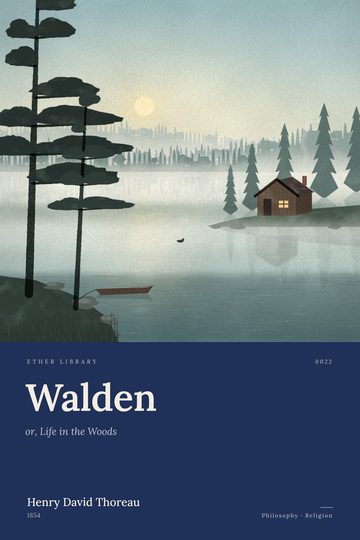
Here's a counterweight we couldn't resist. In 1854, as the telegraph was racing across the country, Henry David Thoreau wrote in the "Economy" chapter of Walden:
Our inventions are wont to be pretty toys, which distract our attention from serious things. They are but improved means to an unimproved end.
And a few lines later, the line that still makes us laugh:
We are in great haste to construct a magnetic telegraph from Maine to Texas; but Maine and Texas, it may be, have nothing important to communicate.
Thoreau was not in anybody's 0.9 percent. If anything, he's the guy at the back with his arms folded. But his point fits surprisingly well with the second half of Park's lecture. Park told students to ride the wave, and in the same breath told them not to chase money, to keep asking why, and to feed their minds with art and philosophy. In Thoreau's terms: don't just improve the means. Improve the end.
If AI lets you produce ten reports before lunch, the question that's left is whether any of them say something worth saying. Email beat paper letters because people had things to tell each other. Park says email first clicked for him when a classmate's reunion notice landed in his inbox addressed to 170 people; he hit "reply all," and within two days long-lost classmates were pouring back into his life. Our hunch is that the eye that spots a W early and the mind that knows what to do with it are the same muscle. People who've spent time thinking hard about something, in their own words, are the ones who can tell how far a new tool can actually carry that thinking.
One question to take with you
When we finished rewatching the lecture, what we wrote down wasn't a resolution. It was a question: What have I recently waved off as "not for me" without ever really trying it?
Pick one this week and give it thirty honest minutes. An AI tool you've been avoiding, the app your kid won't stop talking about, the new place in town. If it still seems pointless afterward, great. That's a judgment, not a shrug, and it puts you in a different spot even with the same answer.
Then ask Thoreau's question too: if this tool works, what do I actually want to say with it?
You can read Walden free in the Ether Library; the "Economy" chapter is long, but it's a great cold shower on a day when the headlines are breathless. And if you understand Korean, or don't mind auto-translated captions, listen to Park himself. His hesitations and jokes don't survive a summary.
Sources
- Park Kyung-chul, "In Search of W" (W를 찾아서), special lecture at Ajou University, 2008. YouTube re-upload by the channel 부자일기, January 12, 2022 (part one checked against its transcript): https://www.youtube.com/watch?v=WCNeAWsLuLk
- Another re-upload of the same lecture, channel 카이로스 생산자 셀아빠, February 7, 2024: https://www.youtube.com/watch?v=6BkpMtg76XA
- 오늘 공부 노트! (newsletter), lecture notes, parts 1 and 2, April 2022 (Korean): https://maily.so/today.study.note/posts/b702ac87 and https://maily.so/today.study.note/posts/ye9o0qm4z8w
- Brunch blog @gyun7902, notes on "In Search of W," 2022 (Korean): https://brunch.co.kr/@gyun7902/46
- Brunch blog @carpediem7760, "The Fourth W" (Korean): https://brunch.co.kr/@carpediem7760/54
- Olivia Sidoti and Colleen McClain, "34% of U.S. adults have used ChatGPT, about double the share in 2023," Pew Research Center, June 25, 2025: https://www.pewresearch.org/short-reads/2025/06/25/34-of-us-adults-have-used-chatgpt-about-double-the-share-in-2023/
- Clifford Stoll's 1995 Newsweek column and his later reply, as reproduced by The Hustle (2024): https://thehustle.co/newsweek-1995-internet-will-fail and The Next Web, February 27, 2010: https://thenextweb.com/shareables/2010/02/27/newsweek-1995-buy-books-newspapers-straight-intenet-uh/
- Henry David Thoreau, Walden (1854), "Economy," quoted from the Ether Library English edition.
Made by people and AI together. The EtherXync team sets the topic and direction; research and drafting are done with an AI (Claude). Quotes and numbers are checked and sourced. How we make it