Why Reading and Writing Still Matter in the Age of AI (and What the Research Can't Tell Us Yet)
Why do reading and writing still matter when AI writes for us? What the OECD literacy data, a Microsoft survey, and a Harvard-BCG experiment show, honestly.
Contents
In December 2024, the U.S. Department of Education quietly released some numbers that should have made more noise. The OECD's Survey of Adult Skills had tested adults in 31 countries and economies, and American literacy scores had dropped. The average U.S. score fell from 271 in 2017 to 258 in 2023. The share of adults scoring at the lowest level, Level 1 or below, rose from 19% to 28%. Peggy Carr, then commissioner of the National Center for Education Statistics, described a "dwindling middle" in American skills.
Now put that next to the other big story of the same two years. Hundreds of millions of people started using AI chatbots, tools whose entire input and output is text. You type words in. Words come back. Then you decide what to do with them.
That combination raises an obvious question. If machines can read the report and write the email, does it still matter whether we can? The common answer is "less and less." The research, read carefully, points the other way. But it's worth being exact about what it shows and what it doesn't, because this topic attracts a lot of confident claims that the studies can't support.
The case that literacy matters less
Let's give the "less" side its strongest version first, because it has real evidence behind it.
In 2023, the MIT researchers Shakked Noy and Whitney Zhang published an experiment in Science. They gave 453 college-educated professionals realistic writing tasks, like press releases and short reports, and let some of them use ChatGPT. The ChatGPT group finished about 40% faster, and their work was rated about 18% higher in quality. And here's the part that matters for us: the gap between weaker and stronger writers narrowed. People who wrote less well on their own got the biggest boost.
That's a genuine finding, and it's good news in a lot of ways. If you've ever struggled to get a cover letter onto the page, AI helps. On the narrow job of producing a polished draft, raw writing skill matters less than it used to.
But producing a draft was never the whole job. And when researchers look at the rest of the job, the picture changes.
Where the work actually moves
In 2025, a team from Microsoft Research and Carnegie Mellon University presented a study at CHI, one of the big computing conferences. They surveyed 319 knowledge workers who used generative AI at least weekly and collected 936 real examples of them using it at work. Their summary of what changes is worth quoting: generative AI "shifts the nature of critical thinking toward information verification, response integration, and task stewardship."
Put plainly, you spend less time gathering information and writing first drafts, and more time checking, combining, and deciding. That's still reading and writing. It might be the hardest kind: reading something fluent and confident and figuring out whether it's right.
The same survey found a pattern that's easy to remember. Workers who had more confidence in the AI reported doing less critical thinking. Workers who had more confidence in themselves, and in their own ability to evaluate the AI's output, reported doing more. The obvious caution: it's a survey of what people say they do, not a measurement of what they did, and most of the authors work at a company that sells AI tools.
What happens when people don't check? The clearest evidence comes from a field experiment run by researchers from Harvard Business School, Wharton, MIT, and others with 758 consultants at Boston Consulting Group. On tasks the AI was good at, consultants with GPT-4 finished more of the work, about 25% faster, at noticeably higher quality. But on a task deliberately chosen to sit just outside what the AI could do well, a business case built so that a convincing answer and the correct answer weren't the same thing, the results flipped. Consultants without AI got the right answer about 84.5% of the time. With GPT-4, it was 70.6%. With GPT-4 and a short prompting tutorial, 60%. The researchers called the boundary a "jagged technological frontier": AI is brilliant at some tasks and quietly wrong at nearby ones, and you can't always tell which side you're on.
The consultants who stumbled weren't careless people. They were handed a convincing answer and didn't read it hard enough against the evidence in front of them.
What no study has shown (yet)
Here's where honesty matters. You might expect there's a study showing that people who read lots of books are better at using AI. We looked. We couldn't find one that measures reading habits, like books per year, and then tests how well people use or evaluate AI. If one exists, we'd love to see it.
What we found instead are pieces that point in the same direction:
Education and critical thinking. A 2025 study by Michael Gerlich in the journal Societies surveyed and interviewed 666 people across age groups and education levels. It found that heavier AI use went with lower critical thinking scores, and that people offloading thinking to the tool seemed to explain part of that link. Higher education went with stronger critical thinking regardless of AI use. But it's correlational, from one researcher, using self-reports, so it can't tell us what causes what.
Writing trains reading. Long before chatbots, Steve Graham and Michael Hebert reviewed experimental studies for the Carnegie Corporation in a 2010 report called Writing to Read. Their main finding: having students write about what they read, through summaries, notes, and answering or creating questions, improved their reading comprehension. Writing isn't just output. It's one of the main ways we learn to understand text.
Brain activity while writing. The MIT Media Lab's "Your Brain on ChatGPT" study, posted in June 2025 by Nataliya Kosmyna and colleagues, measured brain activity in 54 students writing essays with ChatGPT, with a search engine, or with nothing. The unaided writers showed the most brain connectivity, and they were better able to quote their own essays afterward. It drew huge attention, but it was released as a preprint ahead of peer review, with small numbers, and the authors themselves warned against overreading it.
Put those together and you can say something modest but useful. AI moves the hard part of knowledge work from producing text to judging text. The skills that judging requires, close reading, noticing what's missing, checking a claim against evidence, are the same skills that reading and writing train. And people who trust their own judgment seem to use it more. What the research can't say yet is that reading novels on the weekend will make you a better prompt writer. That's a reasonable guess. It isn't a finding.
Mill on the other side of the case
John Stuart Mill never saw a chatbot, but in On Liberty he described the exact trap the BCG consultants fell into. In the chapter on freedom of thought, he warns that knowing an argument for something isn't the same as understanding it:
He who knows only his own side of the case, knows little of that. His reasons may be good, and no one may have been able to refute them. But if he is equally unable to refute the reasons on the opposite side; if he does not so much as know what they are, he has no ground for preferring either opinion.
An AI answer usually arrives as one side of the case, beautifully argued. It doesn't hesitate or hedge the way a nervous colleague might. Mill's point is that a good argument you can't test isn't knowledge; it's just an opinion you happen to be holding. To own a conclusion, you have to know what could be said against it.
Where does that ability come from? Mostly from years of reading people who disagree with each other, and from the uncomfortable work of writing your own argument and discovering where it falls apart. A chatbot can hand you both sides if you ask. Knowing that you need to ask, and recognizing when the other side is strong, is the part you have to bring yourself.
A small practice for the AI age
None of this means you should stop using AI. It means reading and writing are no longer only about producing things. They're how you stay the person in charge of the result. A few habits that put that into practice:
Write one sentence before you prompt. Before you ask, jot down what you actually think the answer is, even if it's a guess. Then compare. You'll notice when the AI changes your mind and when it just talks you out of something you knew.
Read the output like a skeptical editor. Ask: What's the claim? What's the evidence? What's missing? If you can't summarize it in your own words, you haven't read it yet.
Ask for the other side. Mill's test, as a prompt: "What's the strongest argument against this?" Then decide which side holds up better, yourself.
Keep some writing all yours. A journal, a weekly note to your team, the first draft of anything you'll have to defend. These are the reps that keep the evaluating muscles working.
Keep reading long things. Not because there's a study proving it'll make you better with AI, but because long reading is where you practice holding an argument in your head long enough to test it. And you don't have to finish every book to get that practice, as we wrote yesterday in why one sentence can be the whole win.
The machines can write now, and they write well. That makes the reader in the loop more important, not less. Somebody still has to know whether it's true.
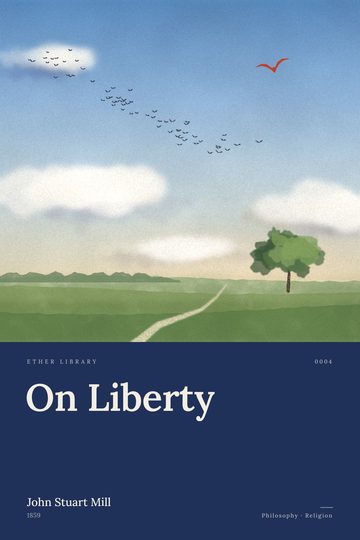
You can read On Liberty free in the Ether Library. Chapter II, on freedom of thought, is the one Mill is quoted from above.
Sources
- National Center for Education Statistics, "U.S. Adults Score on Par with International Average in Literacy Skills, Below International Average in Numeracy and Adaptive Problem Solving," December 10, 2024 (PIAAC 2023): https://ies.ed.gov/learn/press-release/u-s-adults-score-par-international-average-literacy-skills-below-international-average-numeracy-and
- Shakked Noy and Whitney Zhang, "Experimental evidence on the productivity effects of generative artificial intelligence," Science, July 2023: https://scale.stanford.edu/publications/experimental-evidence-productivity-effects-generative-artificial-intelligence
- Hao-Ping (Hank) Lee et al., "The Impact of Generative AI on Critical Thinking: Self-Reported Reductions in Cognitive Effort and Confidence Effects From a Survey of Knowledge Workers," CHI 2025: https://advait.org/files/lee_2025_ai_critical_thinking_survey.pdf
- Fabrizio Dell'Acqua et al., "Navigating the Jagged Technological Frontier," Harvard Business School working paper, 2023 (later published in Organization Science). Summary: Digital Data Design Institute at Harvard: https://aiinstitute.hbs.edu/back-to-the-beginnings-of-ai-at-work/
- Michael Gerlich, "AI Tools in Society: Impacts on Cognitive Offloading and the Future of Critical Thinking," Societies 15, no. 1 (2025): https://tagteam.harvard.edu/hub_feeds/2087/feed_items/13131139/content
- Steve Graham and Michael Hebert, Writing to Read: Evidence for How Writing Can Improve Reading, Alliance for Excellent Education / Carnegie Corporation of New York, 2010: https://lincs.ed.gov/professional-development/resource-collections/profile-432
- Nicola Jones, "Does Using ChatGPT Change Your Brain Activity? Study Sparks Debate," Scientific American (from Nature), June 2025, on Kosmyna et al., "Your Brain on ChatGPT" (arXiv preprint): https://www.scientificamerican.com/article/does-using-chatgpt-really-change-your-brain-activity
- John Stuart Mill, On Liberty (1859), Chapter II, quoted from the Ether Library English edition.
Made by people and AI together. The EtherXync team sets the topic and direction; research and drafting are done with an AI (Claude). Quotes and numbers are checked and sourced. How we make it