The Thucydides Trap, Explained: What an Ancient Greek War Says About the U.S. and China
The Thucydides Trap explained: what Thucydides actually wrote, Graham Allison's 16 cases, the critics, and why Xi Jinping raised it with Trump in 2026.
Contents
In May 2026, at the Great Hall of the People in Beijing, Xi Jinping looked across a long table at Donald Trump and asked a question that sounded like it came from a seminar syllabus: "Can China and the United States overcome the Thucydides Trap and create a new paradigm of major country relations?"
It's a little strange, when you think about it. Two heads of state, one of them presiding over the world's second-largest economy and the other over the largest, and the frame they reach for is a war between two Greek city-states that ended in 404 BC. Nobody at that table needed a history lesson to know the stakes. So why Thucydides?
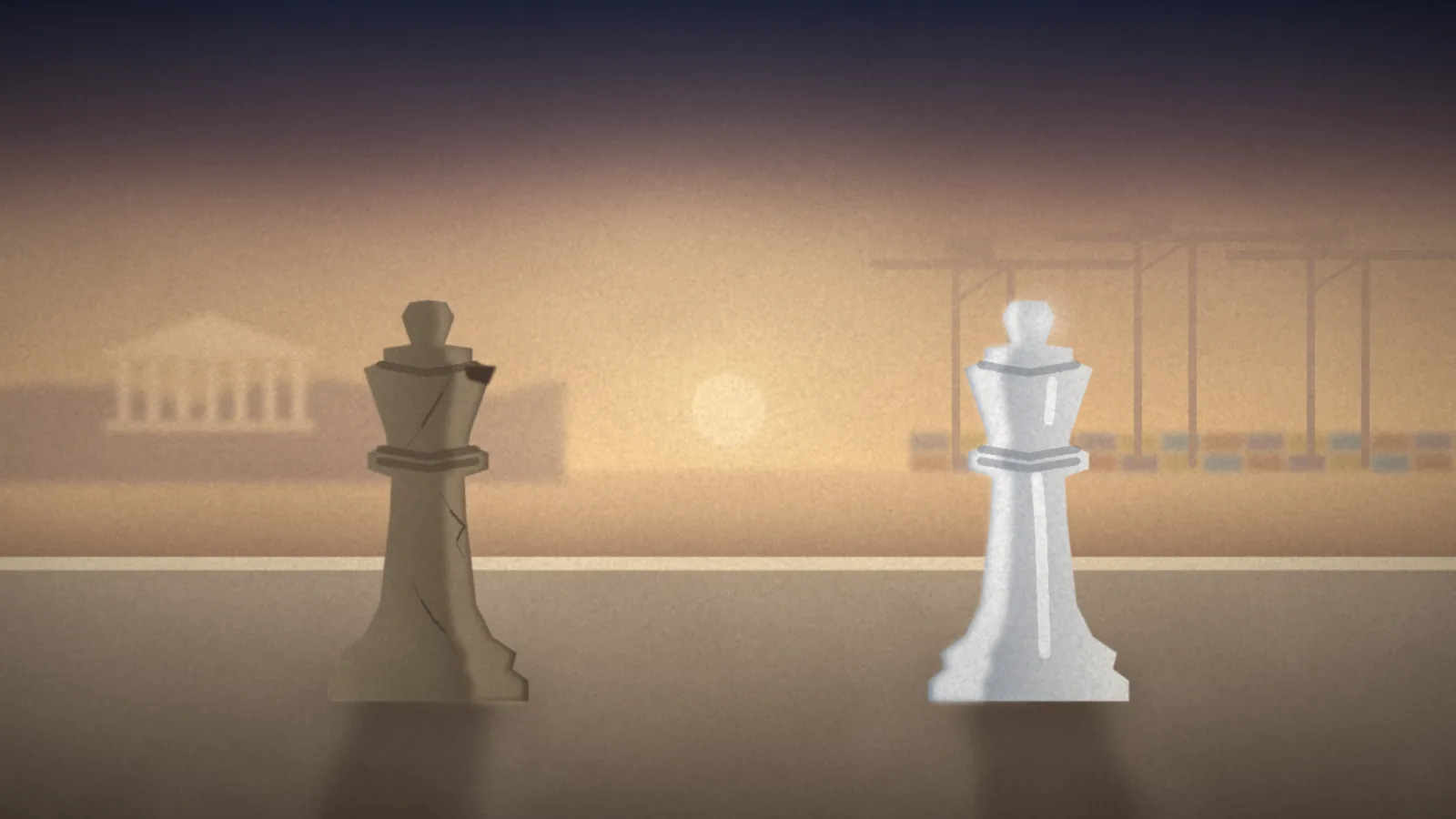
Because the phrase has become shorthand for the most worrying idea in international politics: that when a rising power threatens to displace a ruling one, war tends to follow, whether anyone wants it or not. This post is about where that idea comes from, how much weight it can actually bear, and what an Athenian general who lost his command can still teach the rest of us about reading the news.
What Thucydides actually wrote
Thucydides was an Athenian who served as a general in the war between Athens and Sparta, failed to save a city he was sent to defend, and was exiled for it. He spent the next twenty years doing something nobody quite had before: writing a history that tried to explain events by human causes rather than the moods of gods.
Early in Book 1, after laying out all the public quarrels that led to war (a dispute over the island of Corcyra, a revolt at Potidaea, trade sanctions on Megara), he steps back and says, in effect, none of that is the real story. In Richard Crawley's 1874 English translation:
The real cause I consider to be the one which was formally most kept out of sight. The growth of the power of Athens, and the alarm which this inspired in Lacedaemon, made war inevitable.
Lacedaemon is Sparta. That one sentence is the entire seed of the Thucydides Trap. Notice that it has two halves. One is a fact about power: Athens was growing. The other is a fact about feeling: Sparta was afraid. Thucydides doesn't say the growth alone caused the war. He says the growth plus the fear did.
He was also unusually frank about why he bothered writing it all down. He expected his book to be useful "by those inquirers who desire an exact knowledge of the past as an aid to the interpretation of the future, which in the course of human things must resemble if it does not reflect it." He called it "a possession for all time." That's a bold claim for a war correspondent. Twenty-four centuries later, presidents are still quoting him, so he may have had a point.
How Graham Allison turned a sentence into a theory
The modern phrase belongs to Graham Allison, a Harvard political scientist. He used it in a 2012 Financial Times piece, expanded it in The Atlantic in 2015, and made it the spine of his 2017 book Destined for War: Can America and China Escape Thucydides's Trap? (The underlying comparison is older. The novelist Herman Wouk compared the Cold War to Athens and Sparta in a 1980 lecture at the U.S. Naval War College.)
Allison's team at Harvard's Belfer Center looked back over the last 500 years and identified 16 cases in which a rising power challenged a ruling one. Their count: 12 ended in war. Four did not.
That ratio is what made the idea famous. Twelve out of sixteen sounds like a law of nature. But Allison himself pushes back on the fatalism. His book's subtitle is a question, and his argument is that war is not inevitable. It's the default outcome when leaders let the structural strain run its course, and avoiding it takes unusual effort and imagination.
The four exceptions are the interesting part. One of them is the United States itself. By the late 1800s, the U.S. had passed Britain as the world's largest economy and was flexing its muscles in the Western Hemisphere. Britain, stretched thin by an empire and worried about a rising Germany closer to home, mostly chose to accommodate. Disputes that could have turned ugly, like the 1895 boundary crisis over Venezuela, were settled by arbitration. Two powers that had fought each other twice became something close to partners. The Cold War is on the list too: the U.S. and the Soviet Union rivaled each other for four decades without a direct great-power war, though with plenty of proxy wars and close calls.
The critics have a point
A theory this tidy attracts critics, and some of them are very good.
Joseph Nye, also of Harvard, has questioned what counts as a "case" in the first place. Change the list and you change the ratio. He has also argued that World War I had plenty of causes besides Germany's rise, and that even the Peloponnesian War can be read differently, with Athens' own troubles playing a bigger role than its rise. Hal Brands and Michael Beckley have argued that the theory may misdiagnose China entirely: the dangerous moment for a rising power, they suggest, can come when its growth stalls and it feels its window closing. Others point out that Thucydides wrote about a world of small city-states with spears and triremes, not nuclear-armed giants bound together by supply chains.
There's also a translation wrinkle worth knowing. The Greek verb behind "made war inevitable" is about compulsion: the growth and the fear forced the two sides toward war. That's a statement about pressure, not a guarantee. Several scholars argue that reading Thucydides as a prophet of inevitability gets him backwards. His book is full of decisions, speeches, miscalculations, and moments when things could have gone differently.
So here's a fair summary. The Thucydides Trap isn't a law of history. It's a warning label. It says: when power shifts, fear rises, and fear makes people interpret every move by the other side in the worst possible light. That's worth knowing even if the 12-out-of-16 number is softer than it looks.
Machiavelli's darker reply
It's useful to set Thucydides next to another classic, because the two disagree in a way that sharpens the question.
Niccolò Machiavelli, writing The Prince in 1513, admired the way the ancient Romans dealt with rivals. They didn't wait. In chapter 3, in our English edition, he says:
So the Romans, seeing troubles from afar, always remedied them, and never let them run their course in order to avoid a war, because they knew that war is not avoided but only put off to the advantage of others.
Read that next to Allison and you can feel the tension. Machiavelli's advice is the logic that makes the trap so dangerous: if conflict is coming anyway, strike while you still have the edge. That is exactly the reasoning a frightened Sparta might have used. Allison's four peaceful cases are, in a sense, the story of leaders who refused Machiavelli's logic and bet on patience, compromise, and the possibility that a rival's rise could be absorbed rather than crushed.
Neither book settles the argument. But reading them side by side shows you the actual choice. It's not between war and peace in the abstract. It's between two theories of time: the theory that waiting only makes things worse, and the theory that waiting gives both sides room to change.
What this has to do with your Tuesday
You probably aren't negotiating with Beijing this week. But Thucydides' sentence about growth and fear describes a lot of ordinary life, too.
Think of the veteran at work who suddenly finds a younger colleague getting the interesting projects. The colleague hasn't done anything hostile. But the veteran starts reading every meeting invitation, every Slack message, as a sign of a coup. The newcomer, sensing coldness, gets defensive. Within a few months, two people who could have helped each other are in a quiet war that neither of them chose. It's the same two ingredients: a shift in standing, and the fear it inspires.
The useful move Thucydides offers isn't a prediction. It's a question you can ask about any rivalry, global or personal: what is the stated quarrel, and what is the real cause "most kept out of sight"? The stated quarrel is the project assignment, the tariff, the island. The real cause is often the feeling of being overtaken.
Allison's four exceptions suggest the second question: what would accommodation look like here? Not surrender, but the British move around 1900. Deciding which disputes truly matter, settling the rest, and refusing to let fear turn every small thing into a test of strength.
When you read the next headline about Washington and Beijing, try reading it the way Thucydides would. Ignore the adjectives. Look for who is growing, who is afraid, and whether anyone in the room is working to keep the fear from doing the deciding.
We've translated Thucydides' History of the Peloponnesian War into Korean; an English edition isn't in our library yet, but you can browse the free classics we do have in English in the Ether Library, including The Prince.
Sources
- Thucydides, History of the Peloponnesian War, Book 1 (1.22 and 1.23), trans. Richard Crawley (1874), Project Gutenberg: https://www.gutenberg.org/files/7142/7142-h/7142-h.htm
- Niccolò Machiavelli, The Prince (1532), chapter 3, quoted from the Ether Library English edition.
- Ann Scott Tyson, "Beyond the pomp and pageantry, Xi Jinping sent a message to Donald Trump," The Christian Science Monitor, May 15, 2026: https://www.csmonitor.com/layout/set/amphtml/World/Asia-Pacific/2026/0515/Trump-Xi-Beijing-summit-US-China
- "5 traps for Trump and Xi," Newsweek, May 14, 2026 (source of the Xi quotation used above): https://www.newsweek.com/trump-xi-china-thucydides-trap-taiwan-trade-11951022
- Belfer Center for Science and International Affairs, Harvard Kennedy School, "Overview: Thucydides's Trap": https://www.belfercenter.org/thucydides-trap/overview-thucydides-trap
- Graham Allison, Destined for War: Can America and China Escape Thucydides's Trap?, Houghton Mifflin Harcourt, 2017.
- Wikipedia, "Thucydides Trap" (origin of the term, Herman Wouk's 1980 lecture, summary of critics including Joseph Nye, Hal Brands and Michael Beckley): https://en.wikipedia.org/wiki/Thucydides_Trap
Made by people and AI together. The EtherXync team sets the topic and direction; research and drafting are done with an AI (Claude). Quotes and numbers are checked and sourced. How we make it