Does Walking Help You Think? What a Stanford Study, Darwin, and Thoreau Agree On
Does walking help you think? A Stanford study found walking boosted creative ideas, but not every kind of thinking. Plus Darwin's thinking path and Thoreau.
Contents
A few years ago a TikTok creator named Mady Maio posted about something she called the "silent walk": going outside without headphones, no podcast, no playlist, just you and your thoughts. She admitted the first couple of minutes felt like "mayhem" while her brain adjusted. The video took off, and for a while "silent walking" was all over wellness media, presented as a bold new practice.
It is, of course, the oldest practice there is. People have been walking around without earbuds for a few hundred thousand years. But the reaction tells you something real about 2020s life. Many of us have filled every gap in the day with input, so that the simple act of walking with nothing in our ears now feels strange enough to need a name.
The interesting question underneath the trend isn't whether walking is good for you. Your doctor has opinions on that, and you should ask them, not a blog. The interesting question is narrower: does walking actually help you think? And if so, what kind of thinking?
The Stanford walking study
The best-known evidence comes from a 2014 paper by Marily Oppezzo and Daniel Schwartz at Stanford, published in the Journal of Experimental Psychology: Learning, Memory, and Cognition. Across four experiments with 176 college students and other adults, they compared people's creative output while sitting and while walking.
The main test was a classic of creativity research: think of as many unusual uses as you can for an everyday object, like a tire or a button. This is called divergent thinking, the open-ended, many-possible-answers kind. In one experiment, where people did the task first sitting and then walking on a treadmill, their creative output went up by an average of 60 percent while walking.
Two details make the study more interesting than the headline.
First, the scenery barely mattered. Oppezzo assumed walking outside would win easily. Instead, people walking on a treadmill in a small, boring room, facing a blank wall, did about as well as people walking outdoors. Both groups produced roughly twice as many creative responses as people sitting down. "I thought walking outside would blow everything out of the water," she told the Stanford news office. It was the walking itself that seemed to count.
Second, walking didn't help everything. The researchers also gave people a convergent-thinking task, the kind with one right answer. (For example: find the single word that links "cottage," "Swiss," and "cake." The answer is "cheese.") On that test, walkers did slightly worse than sitters.
So the honest version of the finding is this: walking seemed to help with generating lots of ideas, and didn't help with zeroing in on one correct answer. Oppezzo was careful about the limits, too. "We're not saying walking can turn you into Michelangelo," she said. "But it could help you at the beginning stages of creativity."
Put the hype in context
It's worth adding some perspective, because "exercise makes you smarter" is the kind of claim that grows in the retelling.
A 2012 meta-analysis in Brain Research by Yu-Kai Chang and colleagues pooled 79 studies on how a single bout of exercise affects mental performance. The overall effect was positive but small. The authors concluded that "the effects of acute exercise on cognitive performance are generally small," with bigger effects possible for some tasks and some types of exercise. In plain English: a walk is not a performance-enhancing drug for the brain. It's a nudge, and it seems to nudge certain kinds of thinking more than others.
The same caution applies to the most famous walking number of all. The "10,000 steps a day" goal didn't come from a lab. It traces back to a pedometer sold in Japan in 1965 by the company Yamasa, called the Manpo-kei, which roughly means "10,000-step meter." Research since then has been more interesting than the slogan. In a 2019 study of older women led by I-Min Lee at Harvard, women averaging about 4,400 steps a day had lower mortality over the study period than those averaging about 2,700, and the benefit leveled off around 7,500. A 2022 meta-analysis in The Lancet Public Health, pooling 15 studies and about 47,000 adults, found the benefits plateaued at roughly 6,000 to 8,000 steps a day for adults 60 and older, and 8,000 to 10,000 for younger adults.
None of that is a prescription. Bodies differ, and if you have a health condition, the right amount of walking is a conversation for you and a clinician. But it's a useful reminder that a round number on a fitness tracker is a marketing artifact, not a magic threshold.
Darwin's thinking path
Long before anyone put people on treadmills, some of history's most productive thinkers built walking into the center of their workday.
Charles Darwin is the classic example. In 1846, a few years after moving to Down House in Kent, he rented a strip of land from his neighbor and planted it with hazel, alder, lime, hornbeam, and birch. Around it ran a path of sand and stone about a quarter of a mile long. The family called it the Sandwalk. Darwin called it his thinking path.
He walked it every day, for decades, and kept doing so until the final weeks of his life. Those were the years in which he slowly built the argument of On the Origin of Species, which he finally published in 1859 after some twenty years of careful work. His wife Emma even used it as a health gauge. A note in her diary like "4 times Sandwalk" meant he was feeling better.
What strikes me about the Sandwalk is how unglamorous it was. Same loop, same trees, every day. That matches the Stanford finding nicely. Darwin didn't need a mountain vista. He needed a reliable, low-demand way to keep his body busy so his mind could wander.
Thoreau's warning about walking without arriving
If Darwin was the methodical walker, Henry David Thoreau was the evangelist. In his essay "Walking," first given as a lecture in Concord in 1851 and published in The Atlantic Monthly after his death in 1862, he makes a claim that would horrify most modern employers:
I think that I cannot preserve my health and spirits, unless I spend four hours a day at least...
Four hours. Wandering through woods and fields. Most of us can't do that, and Thoreau, who lived for two years in a cabin he built for $28 near Walden Pond, had an unusually flexible schedule.
But a different line from the same essay is the one that speaks most directly to the silent-walk crowd:
I am alarmed when it happens that I have walked a mile into the woods bodily, without getting there in spirit.
He goes on to describe how the business of the village, the work and obligations, would follow him into the trees. Your body is walking, but your mind is still at the office. That's the problem the silent walk is trying to solve. You can walk three miles with a podcast in your ears and never leave your inbox.
Friedrich Nietzsche took the idea even further in Twilight of the Idols (1889). He quotes Flaubert's claim that one can think and write only while seated, and fires back, in one common English translation: "Only thoughts reached by walking have value." Given the Stanford results, a fair reply might be: some thoughts are reached by walking, and others are better checked sitting down.
And if you want a lighter literary witness, there's Elizabeth Bennet in Pride and Prejudice, who walks three miles through the mud to see her sick sister and arrives with her petticoat, as Miss Bingley gleefully reports, "six inches deep in mud." When Miss Bingley needles Mr. Darcy that the adventure must have "rather affected" his admiration of Elizabeth's fine eyes, he answers: "Not at all, they were brightened by the exercise."
How to borrow the idea, without the hype
Here's a modest way to use all of this, taken from the research and the walkers rather than from any promise of genius.
Walk to generate, sit to judge. The Stanford results suggest walking is better for the brainstorming stage than the checking stage. If you're stuck on what to write, what to name something, or how to approach a problem, a walk is a reasonable bet. If you need to proofread, calculate, or pick between two well-defined options, you may do better at a desk.
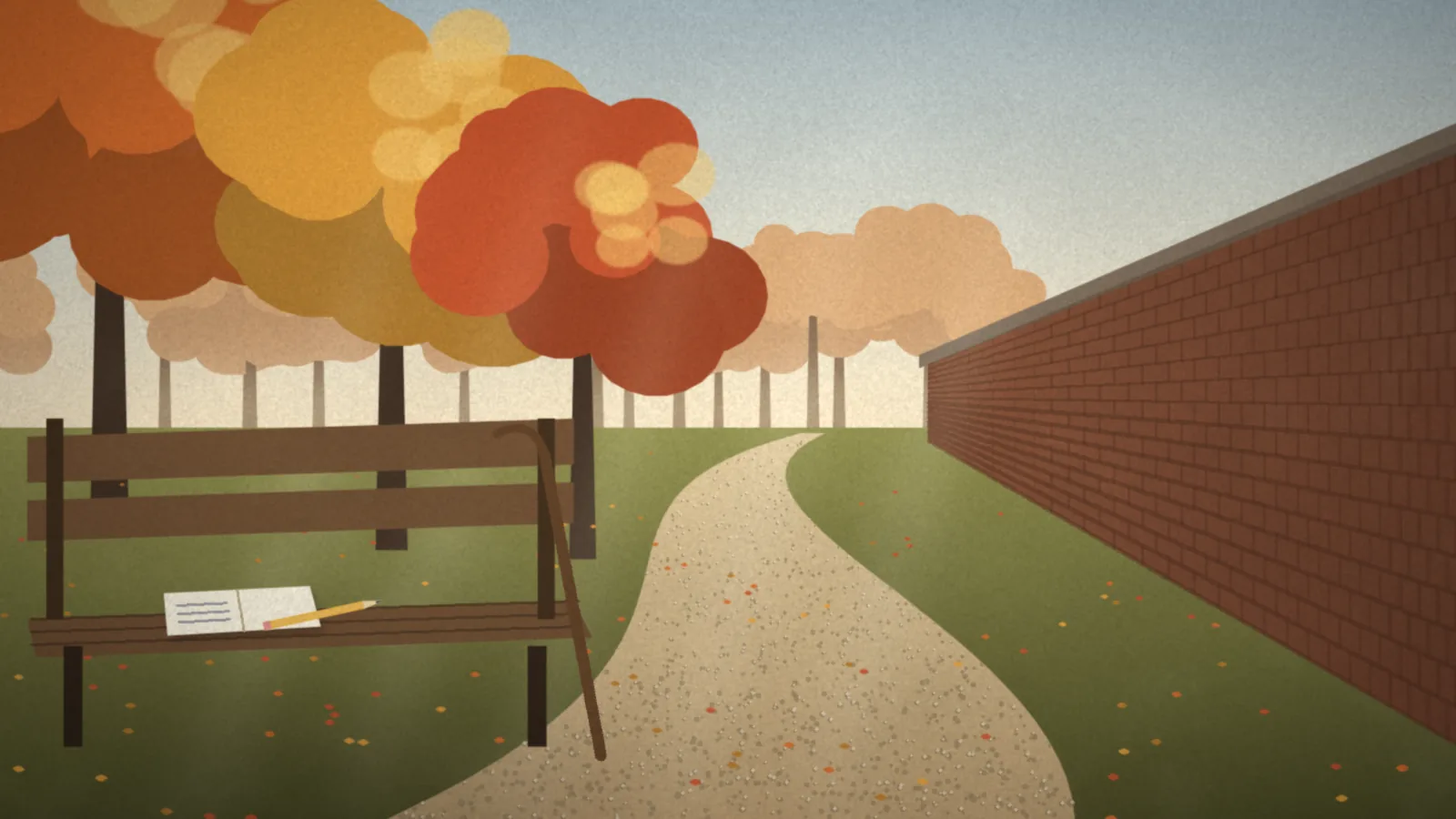
Make it boring on purpose. You don't need a trail. The treadmill-facing-a-wall result and Darwin's same loop every day both point the same way. A route you know well frees attention for thinking. Around the block works.
Try going quiet for part of it. You don't have to give up podcasts forever. But if you want a walk to work as thinking time, try the first ten minutes without anything in your ears. Expect Maio's "mayhem" at first. That restlessness is your mind noticing it isn't being fed.
Carry a way to catch ideas. The point of a thinking walk is what you bring back. A small notebook or a voice memo keeps a good idea from evaporating by the time you're home.
Keep your expectations human-sized. The effects in the research are real but modest. A walk won't fix a bad week or replace sleep, and it isn't medical advice. It's just one of the cheapest, oldest ways to give your mind some room.
Darwin, Thoreau, and a few hundred volunteers in a Stanford lab seem to agree on that much. The next time you're staring at a blinking cursor, it might be worth seeing whether your best idea is waiting about a quarter-mile down the road.
Sources
- Marily Oppezzo and Daniel L. Schwartz, "Give Your Ideas Some Legs: The Positive Effect of Walking on Creative Thinking," Journal of Experimental Psychology: Learning, Memory, and Cognition, 2014. Summary and quotations from Stanford News, April 24, 2014: https://news.stanford.edu/stories/2014/04/walking-vs-sitting-042414
- Y. K. Chang, J. D. Labban, J. I. Gapin, and J. L. Etnier, "The effects of acute exercise on cognitive performance: a meta-analysis," Brain Research, 2012: https://pubmed.ncbi.nlm.nih.gov/22480735/
- Amanda E. Paluch et al., "Daily steps and all-cause mortality: a meta-analysis of 15 international cohorts," The Lancet Public Health, 2022 (summary): https://hospitalhealthcare.com/specialisms/cardiovascular/mortality-benefit-from-higher-daily-steps-plateaus/
- Lauren Leffer, "No, you don't need 10,000 steps a day," Popular Science, August 7, 2025 (origin of the Manpo-kei; I-Min Lee's 2019 study): https://www.popsci.com/health/10000-steps-debunk-science/
- Carolyn Steber, "What Is The Silent Walking Trend?" Bustle, August 22, 2023: https://www.bustle.com/wellness/silent-walking-trend-tiktok
- English Heritage, "Description of Down House" (the Sandwalk as Darwin's "thinking path"): https://www.english-heritage.org.uk/visit/places/home-of-charles-darwin-down-house/history/description/
- Darwin Online, "Charles Darwin: a life in pictures" (renting the land in 1846; Emma Darwin's diary): https://darwin-online.org.uk/life19.html
- Henry David Thoreau, "Walking," The Atlantic Monthly, 1862, text via The Anarchist Library: https://theanarchistlibrary.org/library/henry-david-thoreau-walking.html ; publication history from Wikipedia, "Walking (essay)": https://en.wikipedia.org/wiki/Walking_(essay)
- Friedrich Nietzsche, Twilight of the Idols (1889), "Maxims and Arrows" 34, English text via The Anarchist Library: https://theanarchistlibrary.org/library/friedrich-nietzsche-twilight-of-the-idols.html
- Jane Austen, Pride and Prejudice (1813), chapters 7 and 8, quoted from the Ether Library English edition.
Made by people and AI together. The EtherXync team sets the topic and direction; research and drafting are done with an AI (Claude). Quotes and numbers are checked and sourced. How we make it