The Green Light in The Great Gatsby: What It Means, and Why It Keeps Moving
What does the green light in The Great Gatsby mean? We follow it through all three scenes, from Daisy's dock to the last page, and why it still hits in 2026.
Contents

If you went to high school in the United States, there's a decent chance you wrote a five-paragraph essay about the green light. You probably said it symbolizes the American Dream. You probably got a B-plus.
That answer isn't wrong. It's just flat. The green light in The Great Gatsby is more interesting than a symbol with one meaning stamped on it, because Fitzgerald moves it around. It shows up three times, and each time it means something a little different, and the last time it stops being Gatsby's and becomes ours.
So let's skip the essay and just follow the light.
Scene one: a man reaching for a dot
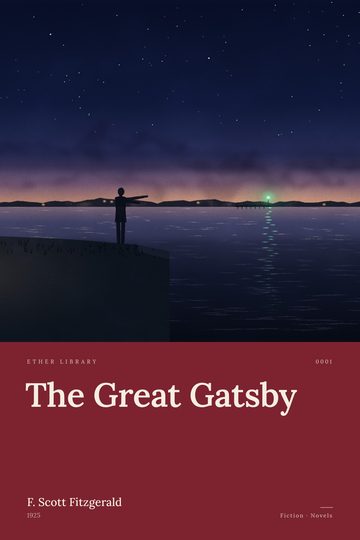
The first time we see it is the end of Chapter 1. Nick Carraway, our narrator, has just moved to West Egg on Long Island. It's 1922. He comes home after an awkward dinner with his cousin Daisy and her husband Tom, and he notices his mysterious neighbor standing alone on the lawn in the dark.
Nick almost calls out, then doesn't. Gatsby stretches his arms toward the water, and Nick swears he sees him trembling.
Involuntarily I glanced seaward—and distinguished nothing except a single green light, minute and far away, that might have been the end of a dock.
Notice how small Fitzgerald makes it. Minute and far away. Might have been. We don't yet know whose dock it is. We don't know why a rich man would reach for a dot. The light starts as pure mystery, and the gesture tells us more than the object does. This is a guy who wants something so badly he's holding his arms out across a bay.
If you only remember one thing from this post, make it this: the green light is less about what Gatsby wants than about the way he wants it.
Scene two: the light goes out (without going out)
In Chapter 5, Gatsby finally gets Daisy into his house. Five years of planning, a mansion bought partly for its view, a summer of enormous parties thrown in the hope she'd wander into one. And now here she is. They're standing at his window, looking out at the mist.
"If it wasn't for the mist we could see your home across the bay," said Gatsby. "You always have a green light that burns all night at the end of your dock."
Then comes one of the best paragraphs Fitzgerald ever wrote.
Possibly it had occurred to him that the colossal significance of that light had now vanished forever. Compared to the great distance that had separated him from Daisy it had seemed very near to her, almost touching her. It had seemed as close as a star to the moon. Now it was again a green light on a dock. His count of enchanted objects had diminished by one.
His count of enchanted objects had diminished by one. That line explains half of adult life. You know the feeling. The job offer, the house, the person, the thing you refreshed your inbox for. While it's far away, it glows. The moment you're close enough to touch it, it turns back into an ordinary object, with ordinary problems, sitting on an ordinary dock.
That's the twist most high school essays miss. Getting closer to Daisy doesn't fulfill the dream. It shrinks it. Gatsby's tragedy isn't only that he can't have the past. It's that the having was never going to match the wanting.
Later, Nick tells him you can't repeat the past. Gatsby's answer is the most American sentence in the book:
"Can't repeat the past?" he cried incredulously. "Why of course you can!"
Scene three: the light becomes everyone's
By Chapter 9, Gatsby is dead and almost nobody came to the funeral. Nick, packing up to go back to the Midwest, walks down to the beach one last night. The big houses are dark. He imagines Long Island as Dutch sailors first saw it, "a fresh, green breast of the new world." There's that color again.
Then the light returns, and this time the pronoun changes.
Gatsby believed in the green light, the orgiastic future that year by year recedes before us. It eluded us then, but that's no matter—tomorrow we will run faster, stretch out our arms further… And one fine morning—
So we beat on, boats against the current, borne back ceaselessly into the past.
Read those lines slowly. "Gatsby believed" becomes "before us," "eluded us," "we will run faster." Nick is no longer describing his neighbor. He's describing a whole country, and quietly, you.
The green light here isn't Daisy anymore. It's the future itself, which by definition stays ahead of you no matter how fast you run. That's what makes the ending so haunting. It's a promise and a trap in the same breath: tomorrow we will run faster. Anyone who has ever said "next year will be my year" knows exactly what that sentence feels like.
A small detail for word nerds: the first edition in 1925 printed "orgastic," and the critic Edmund Wilson changed it to "orgiastic" in a 1941 edition. You'll find both in editions today, including our own, which reads "orgiastic." Either way the sense is a future of wild, almost bodily longing.
So what does the green light mean?
Here's the honest answer, which would have gotten you an A if your teacher was in a good mood. The green light means:
- Daisy, at first. Literally the light on her dock, and the life she represents: old money, ease, the girl from Louisville he lost when he went to war.
- Desire seen from a distance. It's enchanted only while it's out of reach, which is why the middle scene stings.
- Money, maybe. Green is the color of the dollar, and the book is soaked in it. Readers have argued this for decades. Fitzgerald never spells it out, which is why you can't fully rule it in or out.
- The future, and the American habit of believing in it. By the last page, the light belongs to anyone who thinks one more push will get them there.
What it isn't is a single code you crack. Fitzgerald built it to drift, from mysterious to deflated to universal, the way a goal you're chasing looks different at the start, the middle, and the end.
Why Gatsby still lands, 100 years later
When The Great Gatsby came out on April 10, 1925, it was a commercial disappointment. It sold fewer than 20,000 copies by October of that year, far short of what Fitzgerald hoped. He died in 1940 believing himself a failure.
What changed its fate was, of all things, the war. During World War II, the Armed Services Editions program shipped paperback books to American troops, and about 155,000 copies of Gatsby went overseas. A generation of soldiers read it in foxholes and on troop ships, came home, and the book never really left the classroom again.
In 2021 it entered the public domain in the U.S., which is why you can read it free today. And it holds up, maybe more than ever. Swap Gatsby's parties for a perfectly curated feed, his shirts for a dream apartment tour on your phone, and the green light for whatever you're watching from across the bay. Fitzgerald understood something we keep relearning: the reaching is the story.
If you last read it at sixteen, try it again. It's about 48,000 words, an afternoon and an evening, and the book you meet now will be a different one. Our English edition of The Great Gatsby has the first chapter open to anyone. Read Chapter 1, then flip to the last two pages and see if the light looks different from where you're standing now.
New to free classics in general? Start with where to read free classic books online.
Sources
- F. Scott Fitzgerald, The Great Gatsby (1925), quoted from the Ether Library English edition.
- Wikipedia, "The Great Gatsby" (publication date, early sales, public domain): https://en.wikipedia.org/wiki/The_Great_Gatsby
- Carleton College, "Object Lessons: The Great Gatsby, Armed Services Edition": https://www.carleton.edu/voice/stories/object-lessons-the-great-gatsby-armed-services-edition/
- James L. W. West III, "The Great Gatsby," Cambridge University Press blog, 2019 (on "orgastic" and Edmund Wilson's 1941 change): https://cambridgeblog.org/2019/03/the-great-gatsby/
Made by people and AI together. The EtherXync team sets the topic and direction; research and drafting are done with an AI (Claude). Quotes and numbers are checked and sourced. How we make it