7 Behavioral Economics Examples You Run Into Every Week
Behavioral economics examples from everyday American life: 401(k) defaults, "was $199" price tags, tax refunds, and the medium popcorn. What the research shows.
Contents

Classical economics imagines a shopper who looks a lot like a calculator. It knows what it wants, weighs every option, and never buys the medium popcorn just because the large looked silly.
You have met yourself, so you know that's not quite how it goes.
Behavioral economics is the field that takes the calculator seriously and then checks it against what people actually do. It earned Daniel Kahneman a Nobel in 2002 and Richard Thaler one in 2017. And the best way to understand it is not through equations but through examples you'll run into before the weekend. Here are seven, with what the research says and where it's shakier than the TED talks admit.
The big three: defaults, anchors, and decoys
1. Your 401(k) and the power of the default
When Brigitte Madrian and Dennis Shea studied a large U.S. company that switched to automatic enrollment in its 401(k) plan, the change was dramatic. New employees used to have to sign up on their own. Under the new rule, they were enrolled unless they opted out. Participation among new hires jumped by 48 percentage points, according to their 2001 paper in the Quarterly Journal of Economics.
Nobody's preferences about retirement changed overnight. What changed was the box that was already checked. The researchers also found that many people stuck with the default contribution rate and default fund, even when those weren't great for them. Inertia cuts both ways.
The idea was persuasive enough to make it into federal law. Under the SECURE 2.0 Act, most new 401(k) and 403(b) plans set up after December 29, 2022 must automatically enroll employees at 3% or more of pay, rising a point a year to at least 10%, starting with the 2025 plan year. Small and new businesses, church plans, and government plans are exempt.
Try this: look up your actual contribution rate and fund. If you never chose them, someone else did.
2. The "was $199" tag (anchoring)
In a famous 1974 experiment, Amos Tversky and Daniel Kahneman spun a rigged wheel of fortune that landed on either 10 or 65, then asked people what percentage of United Nations member countries were in Africa. Totally unrelated number. And yet the group that saw 10 gave a median guess of 25%, while the group that saw 65 guessed 45%.
That's anchoring: the first number you see pulls your estimate toward it, even when you know it's irrelevant. Retail has known this forever. The crossed-out "was $199" isn't just information about the past. It's an anchor that makes $119 feel like a win.
Federal regulators care about this, by the way. The FTC's Guides Against Deceptive Pricing say a "former price" should be one the item was actually offered at, openly and in good faith, for a reasonably substantial period of time. A price that existed for one afternoon to set up a sale doesn't count. We'll dig into this more right before Black Friday.
3. The medium popcorn (the decoy effect)
Picture a movie theater: small popcorn $7, large $9.50. Lots of people buy the small. Now add a medium at $9. Suddenly the large looks like a steal, because for 50 cents more you get way more popcorn, and sales of the large go up.
The medium here is a decoy. It's not really meant to be bought. It exists to make the large look good by comparison. Researchers Joel Huber, John Payne, and Christopher Puto described this "asymmetric dominance" effect in a 1982 paper, and it's since been found in many lab settings, though how strong it is in real stores is still debated.
Try this: when a three-tier price menu shows up (streaming plans, gym memberships, software), cover the middle option with your thumb and ask whether you'd still pick what you were about to pick.
How money feels inside your head
4. The tax refund that feels like free money
Every spring, millions of Americans get a refund check and treat it like a windfall. A weekend trip, a new TV. But a refund is just your own money, returned without interest, after the government held it all year.
Thaler called this mental accounting: we sort money into imaginary jars, like "bills," "fun," "found money," and spend each jar by different rules. A dollar is a dollar to a calculator. To a person, a dollar from a refund is lighter than a dollar from a paycheck.
Mental accounting isn't all bad. The jars are why envelope budgeting works for some people. The trick is noticing when a jar is fooling you.
5. Save More Tomorrow (present bias, turned around)
Ask people whether they'd like to save more for retirement, and they say yes. Ask them to cut this month's paycheck to do it, and they hesitate. We weigh today's pain much more heavily than tomorrow's.
Thaler and Shlomo Benartzi designed a clever workaround. Their Save More Tomorrow program asked workers to commit now to saving a share of future raises. Since the money came out of raises, take-home pay never went down. In the first company that tried it, participants' savings rates went from 3.5% to 13.6% over four pay raises, a little more than three years, according to Thaler's 2004 testimony to Congress.
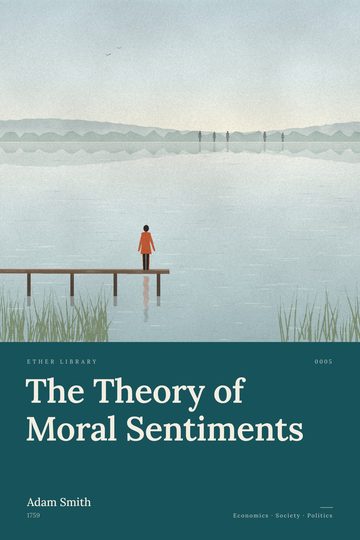
Adam Smith saw the problem almost 250 years earlier, in The Theory of Moral Sentiments:
The pleasure which we are to enjoy ten years hence interests us so little in comparison with that which we may enjoy to-day...
Smith thought the counterweight was our sense of what others would respect. Thaler's answer was plumbing: build the right thing into the system so willpower doesn't have to.
6. Why a $20 loss stings more than a $20 win (loss aversion)
You find a $20 bill on the sidewalk: nice. You lose a $20 bill: your whole afternoon is ruined. Since Kahneman and Tversky's prospect theory in 1979, economists have argued that losses loom larger than equivalent gains. A big 2024 meta-analysis in the Journal of Economic Literature estimated that, on average, a loss weighs about 1.96 times as much as the same-sized gain.
This one comes with an asterisk. Some researchers, notably David Gal and Derek Rucker, argue loss aversion is far more context-dependent than the textbooks say. We go deeper on that fight in loss aversion explained.
7. The jam study (choice overload, with a big caveat)
You've probably heard this one. Shoppers at a grocery store saw a tasting table with either 24 jams or 6. More people stopped at the big display, but far more people actually bought jam when there were only six. Too many choices, the story goes, paralyze us.
The original study by Sheena Iyengar and Mark Lepper, published in 2000, is real and influential. But when researchers later pooled many attempts to reproduce the effect, they found the average effect was close to zero, with big swings depending on the situation. Sometimes more choice hurts. Sometimes it helps. Sometimes it doesn't matter.
That's a useful lesson about behavioral economics itself. The field is full of vivid stories, and not every vivid story holds up equally well. Defaults and anchoring are about as solid as social science gets. Others, like choice overload, are "it depends."
What Adam Smith already knew
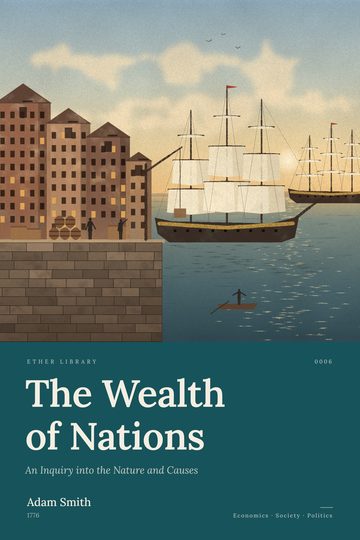
It's common to say that behavioral economics proved Adam Smith wrong, that we're not the rational, self-interested creatures of The Wealth of Nations. You've probably seen the famous line:
It is not from the benevolence of the butcher, the brewer, or the baker that we expect our dinner, but from their regard to their own interest.
But Smith wrote another whole book, years earlier, about how people actually feel and judge: sympathy, envy, vanity, the "impartial spectator" we imagine watching us. Read The Theory of Moral Sentiments after a behavioral economics book and it's a little eerie how much he anticipated. Smith never thought we were calculators. He thought we were people living in markets.
Both books are in the Ether Library in full English editions: The Wealth of Nations and The Theory of Moral Sentiments. The second is the one to start with. It's shorter, warmer, and more surprising.
Sources
- Brigitte C. Madrian and Dennis F. Shea, "The Power of Suggestion: Inertia in 401(k) Participation and Savings Behavior," Quarterly Journal of Economics, 2001: https://www.nber.org/papers/w7682
- James J. Choi, David Laibson, Brigitte Madrian, Andrew Metrick, "For Better or For Worse: Default Effects and 401(k) Savings Behavior," NBER Working Paper 8651, 2001 (summarizing the 48-point increase): https://nber.org/system/files/working_papers/w8651/w8651.pdf
- IRS, "Treasury, IRS issue proposed regulations on new automatic enrollment requirement for 401(k) and 403(b) plans," 2025: https://www.irs.gov/node/141906
- Amos Tversky and Daniel Kahneman, "Judgment under Uncertainty: Heuristics and Biases," Science, 1974. Summary of the wheel experiment: https://bsp.ucd.ie/wp-content/uploads/2019/11/3.pdf
- Federal Trade Commission, Guides Against Deceptive Pricing, 16 CFR Part 233: https://www.ecfr.gov/current/title-16/chapter-I/subchapter-B/part-233
- Richard H. Thaler, testimony before the Joint Economic Committee, March 10, 2004 (Save More Tomorrow results): https://www.jec.senate.gov/archive/Documents/Hearings/thalertestimony10march2004.pdf
- Alexander L. Brown, Taisuke Imai, Ferdinand M. Vieider, Colin F. Camerer, "Meta-analysis of Empirical Estimates of Loss Aversion," Journal of Economic Literature, 2024: https://www.aeaweb.org/doi/10.1257/jel.20221698
- Richard H. Thaler, "Mental Accounting and Consumer Choice," Marketing Science, 1985.
- Joel Huber, John W. Payne, Christopher Puto, "Adding Asymmetrically Dominated Alternatives," Journal of Consumer Research, 1982.
- Sheena S. Iyengar and Mark R. Lepper, "When Choice Is Demotivating," Journal of Personality and Social Psychology, 2000; Benjamin Scheibehenne, Rainer Greifeneder, Peter M. Todd, "Can There Ever Be Too Many Options? A Meta-Analytic Review of Choice Overload," Journal of Consumer Research, 2010.
- Adam Smith, The Theory of Moral Sentiments (1759) and The Wealth of Nations (1776), quoted from the Ether Library English editions.
Made by people and AI together. The EtherXync team sets the topic and direction; research and drafting are done with an AI (Claude). Quotes and numbers are checked and sourced. How we make it